
Minimalist
Jakub Szczęsny
Explore Minimalist in WarsawThe Vandelay collection · Poland
Start with Keret House and Smolna 8. Compare the buildings in our Warsaw collection through their architects, materials and styles, then follow a local style guide to explore further.
7 buildings in this collection 8 styles

What to see
Compare these places through their architecture. Card links open the relevant style or architect guide.
Minimalist
Jakub Szczęsny
Explore Minimalist in Warsaw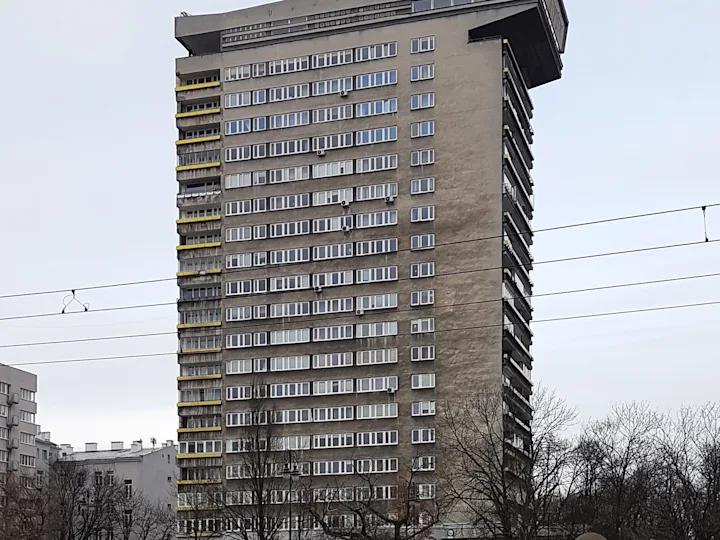
Brutalist · Modernist · Functionalist
Bohdan Gniewiewski, Jan Bogusławski
Explore Brutalist in Warsaw
Green architecture · Postmodernist
Zbigniew Badowski, Marek Budzyński
Explore Green architecture in Warsaw
Contemporary
Stefan Kuryłowicz
Explore Contemporary in Warsaw
Modernist
Andrzej Ustian, Wojciech Kowalczyk
Explore Modernist in Warsaw
Sacred · Contemporary
Andrzej Mikulski, Wojciech Kuryłowicz
Explore Sacred in Warsaw
Sacred · Brutalist
Marta Siekiewicz, Wojciech Siekiewicz
Explore Sacred in WarsawFollow an interest
These are the most represented styles in our city collection. Each link stays within Warsaw.
Start with Temple of Divine Providence and Church of Virgin Mary, Mother of the Church.
Start with Wolf Bracka and Temple of Divine Providence.
Start with Smolna 8 and Church of Virgin Mary, Mother of the Church.
A closer look
Our Warsaw collection includes 7 buildings across 8 architectural styles, a compact but layered collection that reflects the city's cycles of destruction and reinvention. The most represented styles are Modernist and Contemporary, each with buildings that bridge the sacred and the civic.
What makes Warsaw architecturally distinct is the collision of scales and ideologies: Jan Bogusławski's Smolna 8 — a Brutalist-Functionalist hybrid from the socialist era — shares the city with Stefan Kuryłowicz's Wolf Bracka, a glass-and-steel contemporary tower. Sacred architecture runs through the catalogue like a thread: the Church of Virgin Mary, Mother of the Church and the Temple of Divine Providence represent two generations of monumental religious building. Jakub Szczęsny's Keret House, wedged into a gap between buildings, is the opposite extreme — architecture at its most minimal.
Use the buildings in our Warsaw collection to compare architectural forms, materials and details. The style links above show the current catalogue coverage.
Socialist-era buildings with raw concrete finishes and modular repetition. Smolna 8 combines Brutalist massing with Functionalist planning — look for the exposed structural grid and deep window recesses. The Church of Virgin Mary uses Brutalist concrete for sacred effect: heavy, sculptural forms that channel light through narrow openings.
Post-transition Warsaw embraced glass, steel, and green architecture. The Warsaw University Library by Budzyński features a rooftop garden as architectural statement. Wolf Bracka exemplifies the transparency and structural lightness of 2000s commercial architecture. Look for mixed materials, environmental integration, and buildings that engage with the streetscape rather than sitting behind setbacks.
Warsaw's religious buildings span from mid-century Modernism to 21st-century monumentalism. St. Maximilian Kolbe Church has a restrained Modernist clarity; the Temple of Divine Providence is an ambitious Contemporary work. Look for how each architect uses light, verticality, and material weight to create a sense of the sacred.
Continue exploring with another city in this country’s collection.

Mausoleum in Michniów
Take it with you
Find documented buildings on the map, explore their stories, and see nearby places with live distances in AR.